War, Oil, and Your Electric Bill: Why the Iran Conflict Makes Energy Efficiency Urgent
Iran war is driving energy prices up. Learn why energy efficiency is your best hedge against geopolitical shocks and how to act before summer 2026.
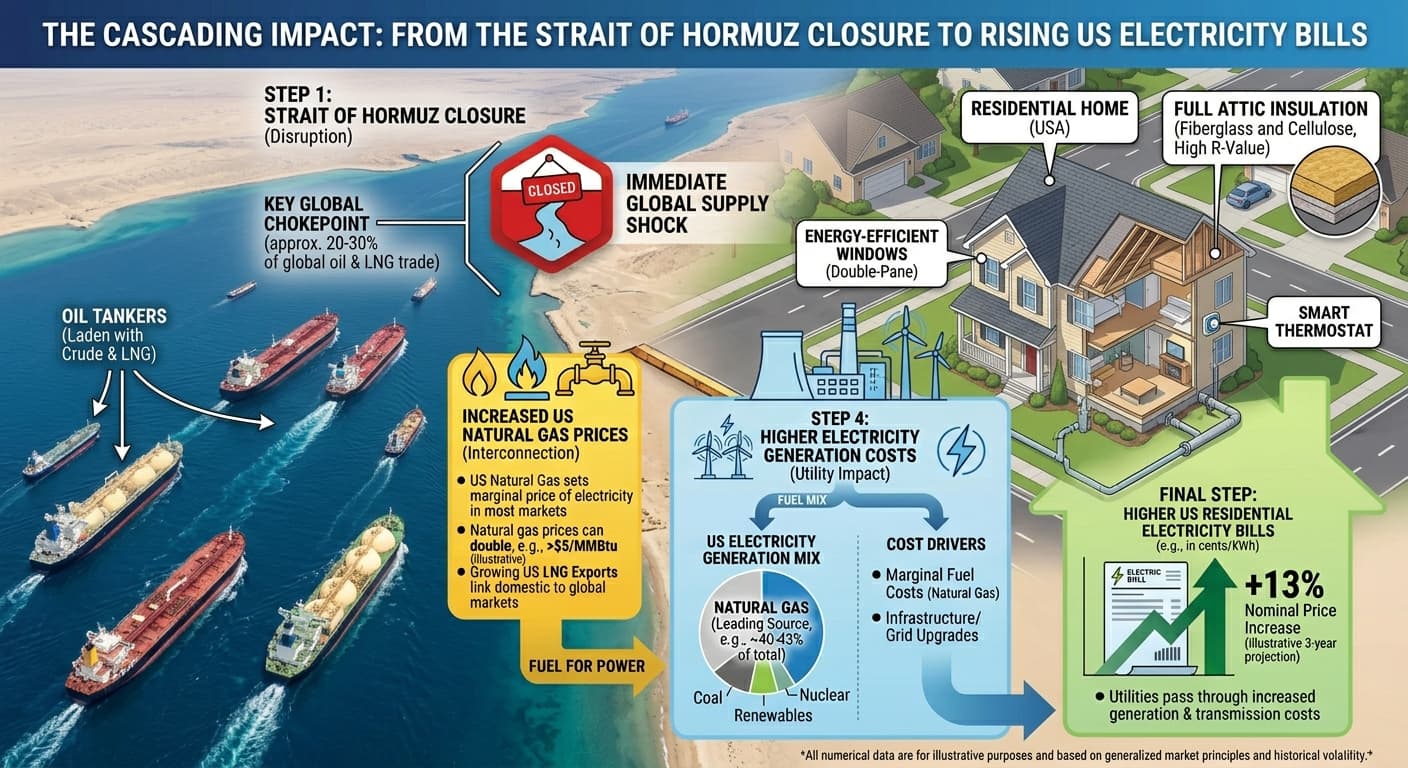
When bombs fell on Iran in February 2026, the first place most Americans felt it wasn't the news — it was the gas pump. The average price of gasoline shot up 48 cents per gallon in a single week.1 But here's what fewer people are tracking: that same shock is heading straight for your electric bill this summer.
The good news? You have more control than you think. And the math for doing something about it has never been stronger.
What Happened in the Strait of Hormuz
The Strait of Hormuz is a narrow waterway between Iran and the Arabian Peninsula. Roughly 20 million barrels of oil pass through it every day — about 20% of the world's total petroleum supply.2 When Iran effectively closed the strait following the outbreak of conflict on February 28, 2026, it triggered the largest energy supply disruption since the 1973 Arab oil embargo.3
The numbers moved fast. Brent crude oil surged past $119 per barrel within days, eventually peaking near $126 — levels not seen since the 2008 oil shock.4 Insurance companies pulled coverage for tankers transiting the strait. Shipping traffic collapsed by roughly 70%.3 And Gulf oil producers were forced to curtail output by at least 10 million barrels per day.4
Key stat: According to the Dallas Federal Reserve, the Strait of Hormuz closure removed close to 20% of global oil supplies from the market — the largest supply disruption in the history of the global oil market.2
This isn't an abstraction. It's the kind of event that cascades through the entire energy system, from the global oil market all the way down to the line items on your monthly utility bill.
How Oil Prices Become Electricity Prices
Here's the connection most people miss: natural gas powers approximately 40% of all electricity generated in the United States.5 And natural gas prices track oil prices. When oil surges, natural gas follows — and so do the rates your utility charges you.
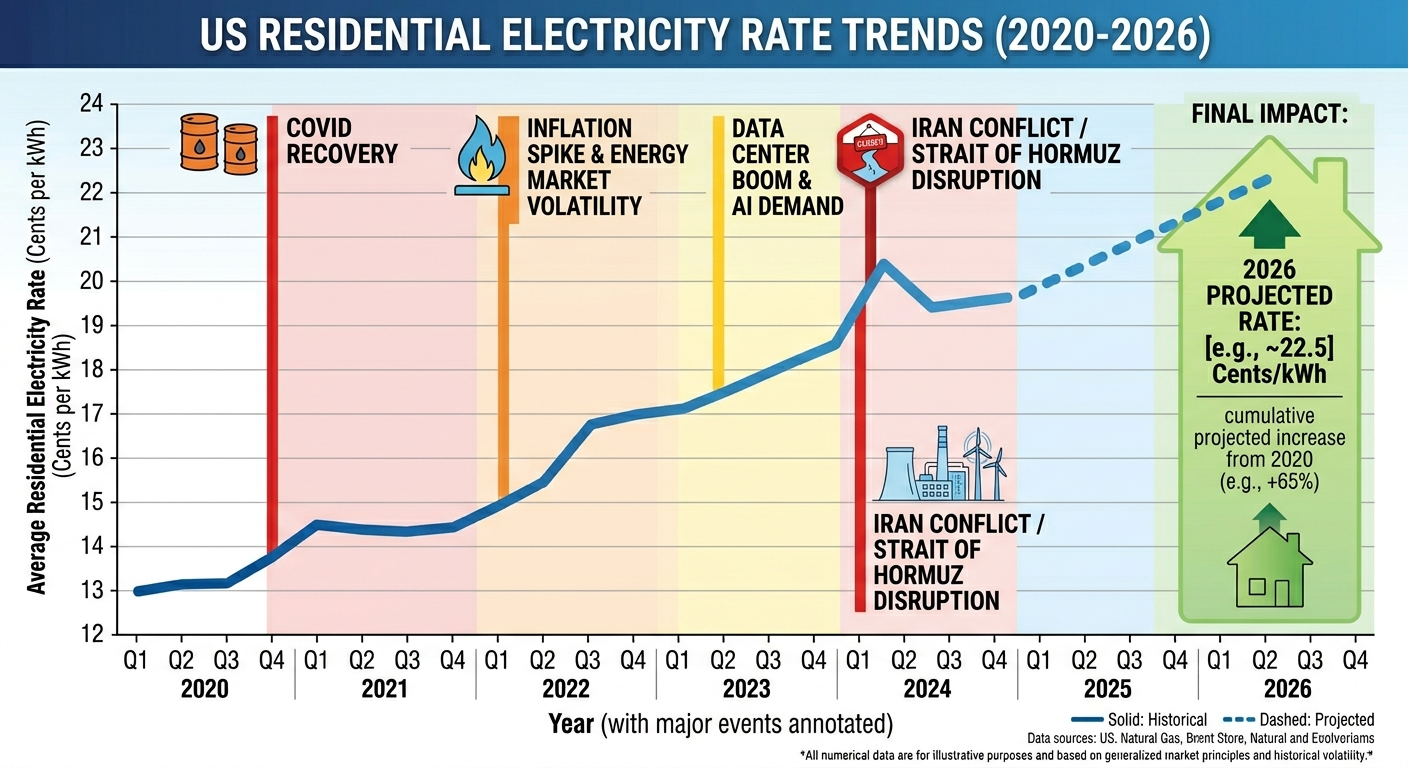
Even before the Iran conflict, the U.S. Energy Information Administration (EIA) projected that average residential electricity rates would climb to 18.02 cents per kilowatt-hour in 2026, up from 17.29 cents in 2025.6 That forecast was issued before bombs started falling.
The structural trajectory is clear: residential electricity prices have risen approximately 36% since 2020, outpacing inflation by a wide margin.7 Data center construction, aging grid infrastructure, and billions in transmission upgrades were already pushing rates higher. The Iran conflict is an accelerant on an existing fire.
Key stat: According to the EIA, residential electricity prices have climbed roughly 36% since 2020, with the average rate projected to reach 18.02 cents per kilowatt-hour in 2026 — and that was before the Hormuz crisis.67
As Chatham House documented in their March 2026 analysis, "US energy prices were set to rise long before the Iran war." Retail electricity prices had already jumped nearly 7% compared to 2024, double the rate of inflation.8 The geopolitical crisis is making a bad trend dramatically worse.
The Structural Problem Beneath the Crisis
It's important to understand that the Iran conflict didn't create the pressure on your energy costs — it exposed and amplified vulnerabilities that were already there.
Three forces were already driving rates upward before a single missile was launched:
Grid modernization costs. Utilities across the country are investing billions in transmission infrastructure, storm hardening, and wildfire mitigation. Those capital costs flow directly through to ratepayers.8
Data center demand. The explosive growth of AI and cloud computing is concentrating enormous new electrical loads in specific regions, tightening power markets and nudging bills higher nationwide. According to the EIA, demand is rising fastest where data centers are clustering — particularly in Texas and the Mid-Atlantic.6
Fuel price volatility. Even without a war, natural gas markets were tightening due to rising LNG export demand. Chatham House notes that US LNG exports are forecast to increase 50% by 2027 compared to 2024, pulling more domestic gas supply into global markets.8
The Iran conflict sits on top of all of this. When the next geopolitical shock comes — and history says it will — these structural pressures will still be there. Which is precisely why efficiency isn't just a good idea right now. It's a permanent hedge.
Energy Efficiency as a Geopolitical Hedge
Every kilowatt-hour you don't consume is a kilowatt-hour that can't be price-shocked by a war halfway around the world.
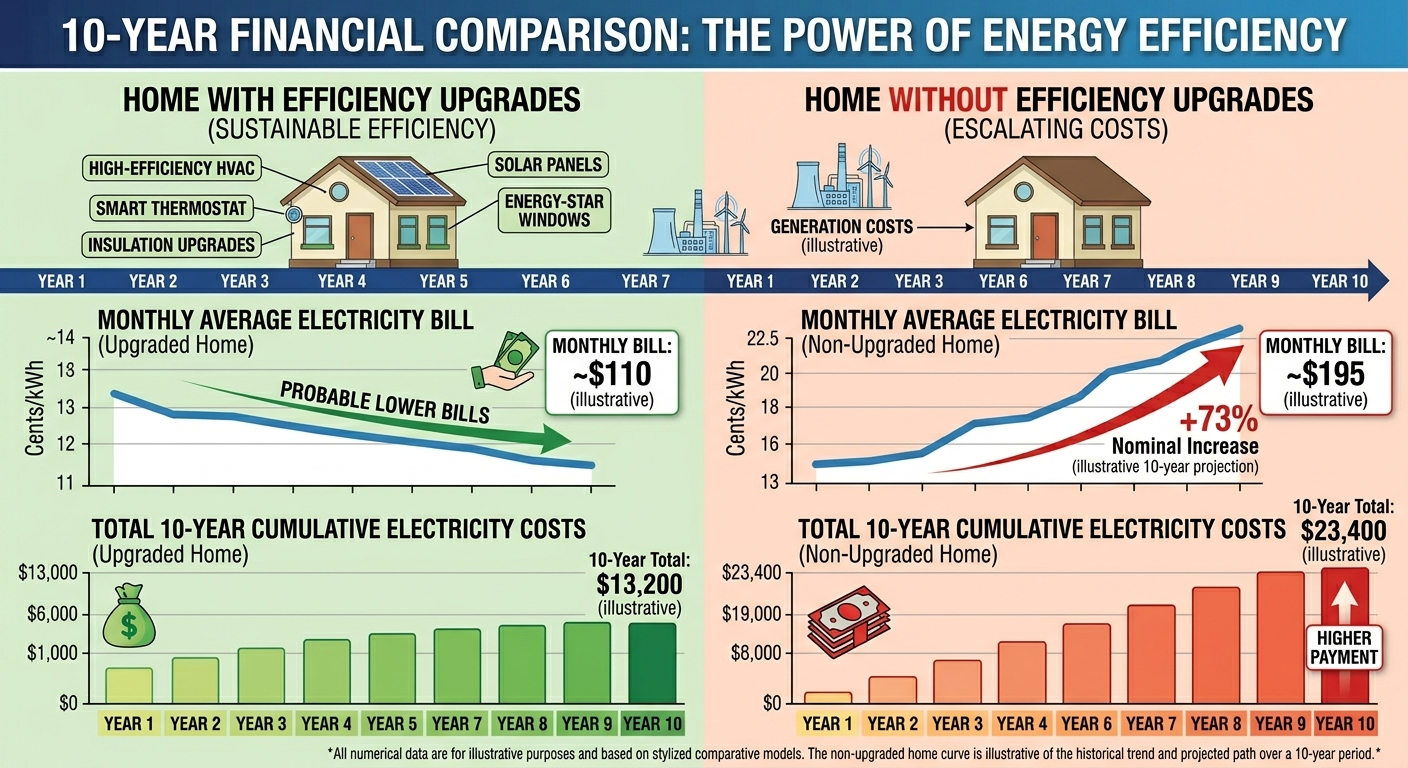
The International Energy Agency calls energy efficiency the "first fuel" — and for good reason.9 Unlike solar panels, which offset generation, efficiency reduces your baseline energy exposure. A well-insulated home with an efficient heating system needs less energy in every scenario: high prices, low prices, stable prices, volatile prices. It's the only investment that wins regardless of what happens in the Strait of Hormuz.
Think of it this way. If your home currently consumes 10,000 kWh per year and you reduce that to 7,000 kWh through efficiency improvements, you've permanently removed 3,000 kWh from the reach of global commodity markets. At current projected rates of 18 cents per kWh, that's $540 per year in savings. If rates climb to 22 cents — which is entirely plausible in a sustained energy crisis — that same efficiency investment saves you $660 per year. The higher prices go, the more valuable your efficiency investment becomes.
This is the math that should be driving decisions right now.
The Payback Math Just Got Better
Rising energy costs compress payback periods for efficiency investments. This is the most important and least understood dynamic in home energy economics.
Consider a straightforward example: a $3,000 insulation and air-sealing upgrade that saves $450 per year at today's rates. That's a payback period of about 6.7 years. But if rates rise to 22 cents per kWh — a scenario that's increasingly realistic — those annual savings climb to roughly $575, and your payback drops to 5.2 years. Every cent of rate increase accelerates your return.
The same principle applies to every efficiency measure:
- Air sealing and insulation: 2–4 year payback at current rates, accelerating as prices rise. This is the highest-ROI move for most homes and the foundation everything else builds on.10
- LED lighting (whole home): Under 1 year payback. If you haven't done this yet, it's essentially free money.
- Smart thermostat: 1–2 year payback. Programmable setbacks alone can reduce heating and cooling costs by 10–15%.
- Heat pump (replacing gas furnace): 5–8 year payback under normal conditions, compressing toward 4–6 years at elevated rates and with available rebates.11
- Heat pump water heater: 3–7 year payback depending on usage and rates, with up to $550 per year in savings.11
Key stat: At projected 2026 electricity rates, efficiency investments that once took 7–8 years to pay back are now paying for themselves in 5–6 years — and that gap widens with every rate increase.
The compounding effect matters too. Weatherize first, and you need a smaller heat pump. A smaller heat pump costs less to install, which means faster payback. Each upgrade amplifies the next. This isn't a one-time decision — it's a stack, and the returns compound.
What to Do Before Summer
If you're going to act — and the math says you should — here's the priority order:
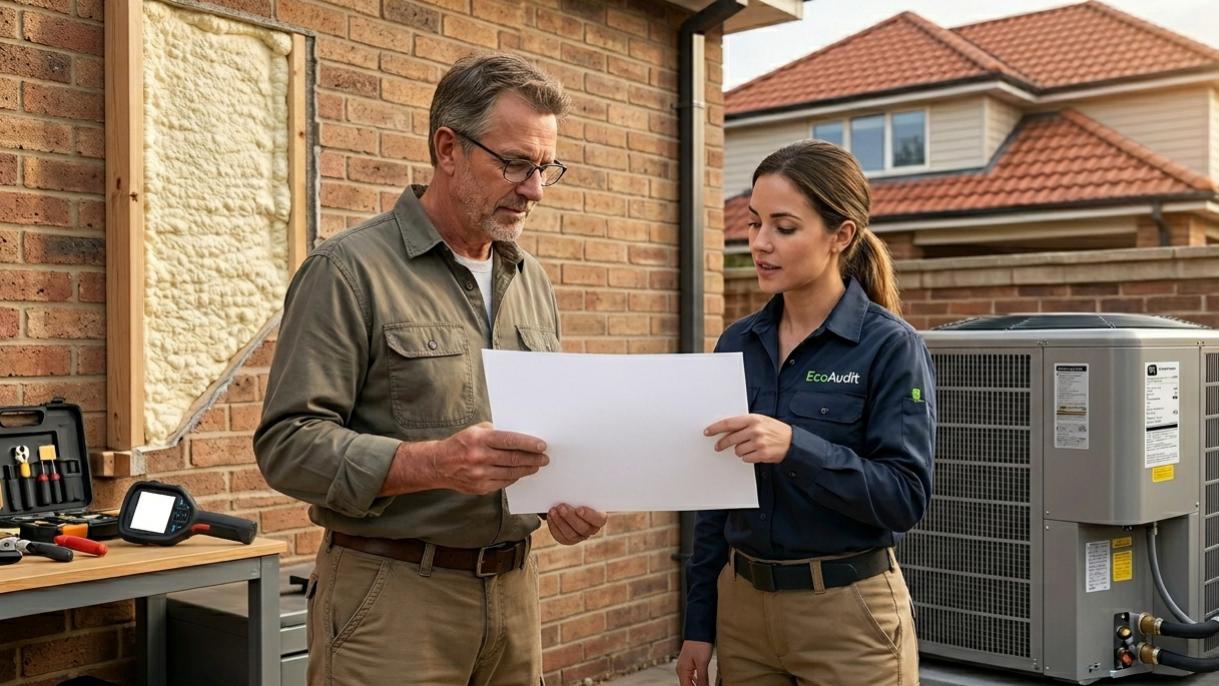
1. Weatherize first. Air sealing and insulation are the foundation. They make every other upgrade work better. A well-sealed building envelope can reduce required heating and cooling capacity by 25–40%, which means smaller, cheaper HVAC equipment and lower operating costs from day one.10
2. Upgrade your heating and cooling. If your furnace or air conditioner is more than 15 years old, a heat pump replacement should be on your radar. Modern heat pumps deliver both heating and cooling at 2–3 times the efficiency of conventional systems.
3. Install a smart thermostat. The easiest win on this list. Automated setbacks during sleeping and away hours add up to hundreds of dollars per year with zero lifestyle change.
4. Complete an LED retrofit. Every fixture. Every lamp. The payback is measured in months, not years.
5. Check your rebates. The federal Section 25C tax credit for air-source heat pumps expired on December 31, 2025. But the IRA-funded HOMES and HEEHRA rebate programs are now active in most states.12 Income-eligible households can receive up to $8,000 toward a heat pump installation. State and utility programs are filling the gap left by the expired federal credit — but allocations are going fast. California's single-family HEEHRA rebates were fully reserved by February 2026.12
Contact your state energy office or visit the Database of State Incentives for Renewables and Efficiency (DSIRE) to check what's available in your area. These programs won't last forever, and the demand is surging.
The Bigger Picture
Buildings are where geopolitics meets your household budget. That's not a metaphor — it's a physical reality.
The energy that heats your home, cools your office, and powers your appliances flows through a system that stretches from oil fields in the Persian Gulf to transmission lines in your neighborhood. Every conflict, every embargo, every market disruption along that chain eventually shows up in the numbers on your bill.
But here's what I keep coming back to: you can't control what happens in the Strait of Hormuz. You can't set global oil prices. You can't decide when the next geopolitical shock hits or how long it lasts. What you can control is how much energy your building needs to function.
Every efficiency investment is a vote for energy independence — yours and the country's. A well-insulated, efficiently heated home saves money in every scenario. It's infrastructure that pays you back. It's a decision that gets smarter as the world gets more uncertain.
The tools exist. The payback math has never been stronger. And the window between now and summer — when rising rates will hit hardest — is exactly the right time to act.
We can either wait for the next crisis to remind us, or we can build the resilience now. Only one of those options actually protects your family's bottom line.
Take Action Now
Your home's energy performance is the one part of this equation you control. Start with the numbers:
- Payback Calculator — See exactly how rising rates accelerate your return on efficiency investments. Pre-filled with your state's current rate and projected increases.
- Energy Score — Get a baseline assessment of your home's energy performance and identify the highest-impact upgrades.
- Rates Tracker — Monitor electricity rate trends in your state and understand what's driving the changes.
References
- Center for American Progress. "The War in Iran Will Raise Fuel Prices and Costs Throughout the Economy." March 2026. Link
- Dallas Federal Reserve. "What the closure of the Strait of Hormuz means for the global economy." March 20, 2026. Link
- Wikipedia. "2026 Strait of Hormuz crisis." Link
- CNBC. "Oil prices: Analysts raise the alarm as crude soars over Iran war." March 9, 2026. Link
- U.S. Energy Information Administration. "Short-Term Energy Outlook: Natural Gas." March 2026. Link
- U.S. Energy Information Administration. "Short-Term Energy Outlook." March 2026. Link
- U.S. Energy Information Administration. "U.S. electricity prices continue steady increase." Link
- Chatham House. "US energy prices were set to rise long before the Iran war." March 11, 2026. Link
- International Energy Agency. "Energy efficiency is the first fuel, and demand for it needs to grow." Link
- Green Building Advisor. "Energy Efficiency Payback Periods Reassessment." 2026. Link
- National Efficiency Supply. "Utility Rebates & Federal Tax Credits for Heat Pumps (2026 State-by-State Guide)." 2026. Link
- AC Direct. "State-by-State HVAC Rebates in 2026: Where Homeowners Are Leaving Money on the Table." 2026. Link
Malachi.Energy is committed to accuracy and transparency. We make every effort to verify all data, statistics, and claims presented in our content using authoritative sources. However, energy markets, policies, and research evolve rapidly. If you spot an error or have a more current source, we welcome corrections — please contact us. This content is for informational purposes and does not constitute professional energy consulting advice.